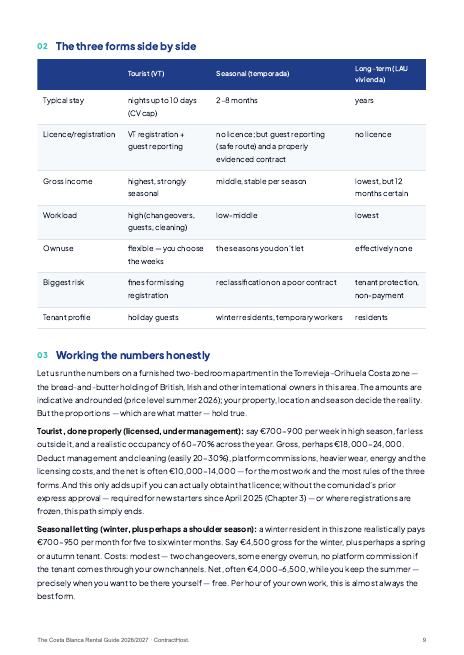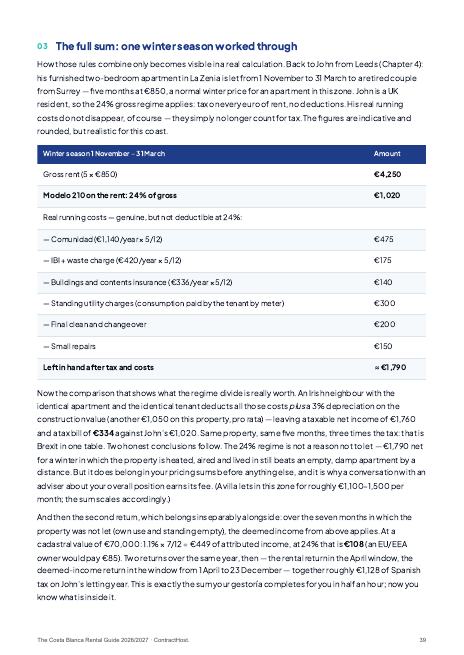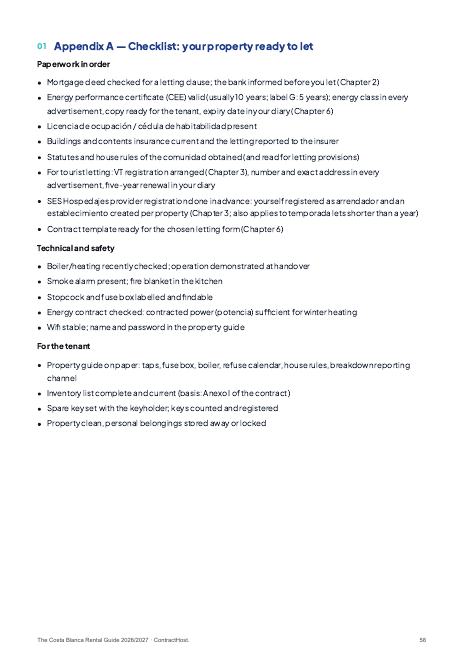
Spanish rental law is changing at speed — rent caps, registration duties, regional decrees, and courts striking parts of them down again. If your contract is more than a year old, it is probably outdated on points that matter. And one wrong contract is enough to give your tenant the right to stay in your house for years — even with “11 months” on paper. So we first establish which contract yóur situation calls for, and build in the rules of your region. You get the Spanish signing contract plus a bilingual instruction document explaining every clause in English — so you know exactly what you are signing.
Current through August 2026 · LAU · Ley 12/2023
You get the right contract type, the legal basis behind it, and the checklist for your region.
Already know what you need? Go straight to the packages, from €79
Five questions, about a minute. You get the contract type that fits your situation, why that is so with the article of law alongside, and the full list of what that contract must contain — including the points nearly everyone forgets.
Letting is Spain's political battleground of the moment: rent regulation, registration duties, regional decrees — and courts then striking parts of them down again. In the last eighteen months alone:
A free template from last year is therefore not “slightly dated” — it can simply be wrong on essential points. That is why every contract we issue carries a reference date, and why we process changes as soon as they appear in the BOE.
The complete contract with every clause and annex, and the generator — in every package. Pay once, no subscription. An abogado or gestoría typically charges €150 to €400 for one bespoke contract.
For residential lets — one contract that lasts for years.
For changing tenants — one winter tenant a year, or a few weeks at a time.
Season promotion until 30 September
For those letting more than one property.
Prices include VAT · Corrections to your details up to 30 days after purchase · The contract and Annual licence: twelve months of revisions when the law changes. One-off is and stays one contract — next season you pay again.
Rated 4.8 on average across 14 reviews from landlords letting in Spain
We suddenly needed a rental contract at short notice, and our gestor couldn't see us for another week. The contract was delivered quickly and looked professional. Nothing needed changing.
Lisa Bakker-GarcíaAlicante
It turned out we had been using an outdated rental contract for years. As we don't speak Spanish ourselves, it was a real relief to finally read exactly what the contract says. That brings much more peace of mind.
Jan & RonTorremolinos
A welcome change from cutting and pasting in Word every single time. We let our property regularly for shorter periods and drawing up a new rental contract was a time-consuming chore each time. Now it's a matter of filling in a few details and the contract is ready. Saves a lot of time.
MichielMadrid
Very handy. This way we know for certain our rental contract stays current and we're not chasing the facts.
Dirk P.Rojales
I couldn't see the wood for the trees any more, especially with all the new rules. Now it's finally clear what we need to account for. Thank you!
H. den HeuvelPinoso
Superb service. This has once again saved me a lot of time and money.
Patricia VeldemaSevilla
Six stars!
Benny VerhulstOrihuela Costa
I honestly didn't know this service existed. Very glad I found it!
S. KoeimanAlmuñécar
After bad experiences with several unreliable agencies, this is a genuine breath of fresh air.
Erwin P.San Pedro del Pinatar
Great to be able to keep everything in one place. Keep it up!
Linda VermolenSan Miguel de Salinas
Now this is what they call innovation :)
Mark & BiancaSantiago de la Ribera
Clarity at last.
Mustafa GülTorrevieja
Good product, illuminating. Recommended!
Wilma VerkerkDénia
Current and convenient.
J. JonckheerOliva
This is not a fill-in-the-blanks template with your name at the top. The generator assembles your contract clause by clause for your regime and your region, from a register we maintain against the legislation in force — with the article of law and the reference date per clause. You answer the questions in plain language and the document comes out fully completed. With The contract you keep generating for twelve months for your property; the Annual licence does the same for up to three properties.
The generator runs inside PropertyHost, the platform these contracts come from. After twelve months, access simply stops — nothing renews and nothing is charged, and the documents you created remain yours. Managing more than three properties? A Keyholder subscription works out cheaper than the Annual licence.
For estate agents, property managers and gestorías there are Office subscriptions: unlimited contracts, an online file archive per client and, from Office M, your own firm's name on the document (white label). From €49 per month, ordered directly — no sales call.
Letting in Spain is mostly passed on by word of mouth: in Facebook groups, on the terrace, from the previous owner. Usually well meant, often years out of date, and sometimes exactly backwards. Below are the seven claims that circulate most — each with its source, so you can check it yourself.
AI assistants and free template contracts — including those from big, familiar names — draw on whatever appears most often on the internet, rarely on the current state of the law. They miss mandatory clauses, apply lapsed obligations and lag behind regional changes. The document looks professional, but legally it fails on precisely the points that matter.
That is why every claim on this site carries its source and its reference date.
| What you hear | What the law actually says | Source |
|---|---|---|
| “Put 11 months in the contract and you're safe.” | The law looks at the purpose of the stay, not its length. Without a demonstrable temporary reason, the court reclassifies to an ordinary residential tenancy — with five years of mandatory extension, seven if you let through a company. | LAU art. 2 and 3.2 |
| “You just keep the deposit yourself.” | That depends entirely on your region, and this is exactly where generic advice goes wrong. Must be lodged: Valencia within one month (fine €600–3,000), Catalonia within two months with INCASÒL, Madrid within 30 days, the Canaries within one month, and the Balearics with IBAVI. No longer: Murcia abolished it in May 2021, Andalucía on 24 January 2026. | Decreto 46/2022 · Ley 13/1996 · Decreto 181/1996 · Ley 2/2014 · Ley 5/2018 · Ley 5/2025 · Decreto-ley 1/2021 |
| “For a short seasonal contract you only lodge part of the deposit.” | Only Catalonia, Galicia and the Basque Country have a pro-rata rule like that. In Valencia, Madrid, the Canaries and the Balearics you lodge the full two months' rent, even on a three-month let. On €600 rent that is €1,200 in Valencia against €300 in Catalonia — for exactly the same contract. | Llei 13/1996 art. 3.2 · Decreto 46/2022 art. 1 |
| “A rent cap is coming, I need to act fast.” | A cap only applies in designated municipalities, and there are 317 of them in five regions. On the Costa Blanca, in Murcia, the Balearics, Andalucía, Madrid and the Canary Islands there is no cap. The Comunitat Valenciana expressly refuses to declare zones. | Ley 12/2023 · BOE 29-07-2026 |
| “Seasonal lets never fall under rent regulation.” | In Catalonia they do, since 1 January 2026. There you must also substantiate the temporary purpose with documents and lodge those together with the deposit at INCASÒL. Without that evidence, your contract counts as a permanent residential tenancy by operation of law. | Llei 11/2025 (Catalonia) |
| “21% VAT on rentals is coming.” | That is a proposal, and on 27 July 2026 it was postponed for lack of a majority. An earlier rental decree was even voted down by Congress in April. What applies today: exempt without hotel-style services, 10% with them, 21% when letting to an operating company. | LIVA art. 20.Uno.23 |
| “A free template off the internet is fine.” | Nearly every free template is a contrato de arrendamiento de vivienda under art. 2 LAU — precisely the contract you do nót want for a seasonal let. People type “11 months” into it and assume that makes it temporary. | see row 1 |
That is exactly what you are buying here: not a file, but the certainty that the right contract type sits underneath it, that the mandatory amounts are correct, and that your region's rules are in it. With the articles alongside, so you can show it to your gestoría or to your tenant.
The advice doing the rounds is simple: put 11 months in the contract and your tenant gets no housing protection. That is not how a Spanish judge looks at it.
The LAU distinguishes on purpose, not duration. A valid seasonal let under art. 3.2 LAU requires a causa objetiva y transitoria: an objective, temporary reason why this tenant needs the property for precisely that period. An academic year, a work posting, a winter stay with a main home kept elsewhere. Art. 3.2 covers seasonal lets expressly “sea ésta de verano o cualquier otra” — whether it is the summer season or any other.
Without that reason, the court reclassifies to an ordinary residential tenancy under art. 2 LAU — and you are bound to the statutory extension of five years, or seven where the landlord is a company. Judges look at things most owners never think of as evidence: the tenant putting the utilities in their own name, a renewal option in the contract, rent paid by the month with no day-count adjustment, or a right-of-first-refusal clause that only belongs in a residential tenancy.
| Aspect | Art. 2 — residential | Art. 3.2 — temporada | Art. 5 — tourist |
|---|---|---|---|
| Purpose | A fixed, permanent home | Temporary stay with a demonstrable motive | Holidays, short stays |
| Mandatory extension | Yes, 5 years (7 for a company) | No, ends on the agreed date | Not applicable |
| Deposit (art. 36.1 LAU) | 1 month, mandatory | 2 months, mandatory | Not governed by the LAU |
| Tourist licence | Not required | Not required | Mandatory, per region |
| Applicable law | LAU in full | LAU art. 3 + civil law | Outside the LAU, regional tourism law |
Many owners nervously stack short contracts because they fear one thing: never getting back in. But the fear of residential tenancies almost always stems from contracts where the protective clauses were missing — not from the law itself.
Choose long-term deliberately and you get a lot in return: fixed rent, twelve months a year, no changeover stress, no empty winter months, no tourist licence and none of the reclassification uncertainty of an engineered seasonal contract. One tenant who pays properly is often more profitable — and always calmer — than ten changeovers a year.
The condition is a contract that is right from day one. The reservation allowing you to reclaim the property after the first year — for yourself, first-degree family or your ex-spouse after divorce (art. 9.3 LAU, private landlords only) — must be in the contract at signing: it cannot be added afterwards, and it is precisely the clause nearly every free template lacks. Our generator includes it as standard, together with the deposit and your region's lodging rules.
The same legislation that powers the generator, written out — with sources and a reference date on every guide.
The checklist to test any free template against — with the statute behind every requirement.
Read the guide
One month or two, where to lodge it and the fines for forgetting — region by region.
Read the guide
Why duration decides nothing, what the court actually looks at and how to record it properly.
Read the guideAll three are possible. The difference is how much you have to research yourself, and what it costs when you miss something.
| Free template | SpanishRentalContract.com | Abogado or gestoría | |
|---|---|---|---|
| Price | €0 | €79 to €199 | €150 to €400 and up |
| The right contract type | No, one template for everything | Yes, based on your situation | Yes |
| English explanation per clause | No | Yes, separate instruction document | Verbally, at an hourly rate |
| Regional deposit rules | No | Yes, named per region | Yes |
| Ready in | Immediately | A few minutes | Days to weeks |
This domain does one thing well: getting you the right contract, fast. Behind it sits PropertyHost, the platform at propertyhost.app that also handles the rest for private landlords in Spain: regional compliance, guest registration and documents, reminders, and legislation tracked for you. And the legal dossier it all rests on is public at propertyhost.es, with the BOE as its source — you can open every reference yourself.
No, neither. You get no ChatGPT template and no outdated model contract off the internet, but a personally tailored document: the generator assembles it for your situation, your regime and your region, from clauses that have each been checked against the Spanish legislation in force — with the article of law and the date the legislation was consulted, per clause.
That difference is not theoretical. AI assistants and free templates draw on whatever appears most often on the internet, not on what applies now: many still mention the deposit lodging with the AVRA that was abolished in Andalucía on 24 January 2026, and miss the Catalan rules that were tightened on 1 January 2026. When the law changes, our template is updated — and you are notified.
Less than you think — provided the contract is right from day one. The stories about owners losing access to their house almost always involve contracts where the protective clauses were missing. With the art. 9.3 LAU reservation — expressly included in the contract at signing — you can, as a private landlord (not through a company), reclaim the property after the first year for yourself, first-degree family or your ex-spouse after divorce, on two months' notice. The statutory deposit and the regional lodging rules cover damage and arrears, and in return you get fixed rental income all year round — no changeover stress, no tourist licence and no reclassification risk. For many owners it is, on balance, the calmest and most profitable choice.
Two months. Article 36.1 LAU makes demanding and providing a deposit mandatory: one month's rent for a residential tenancy and two months' rent for lets for a use other than housing, which includes seasonal lets. Additional guarantees such as a guarantor or bank guarantee may be asked on top.
That differs per region, and it is often forgotten. In the Comunitat Valenciana the landlord must lodge the deposit with the Generalitat Valenciana within one month of signing; that applies to residential tenancies and to lets for other uses alike. Fail to do so and it is a serious infringement with a fine of up to €3,000, plus surcharges and interest.
In Catalonia it runs through INCASÒL, with a two-month deadline. For seasonal contracts you do not lodge the full two months' rent there, but the share pro rata to the term. In the Balearics it goes through IBAVI.
In Andalucía that duty has lapsed. For rental contracts dated from 24 January 2026 the deposit no longer has to be lodged with the AVRA; that was scrapped by Ley 5/2025, the Andalusian housing act. An important detail: only the lódging has lapsed — the deposit itself remains mandatory under art. 36.1 LAU; you now hold it yourself.
Only if your municipality has been designated a zona de mercado residencial tensionado under Ley 12/2023. As at 30 July 2026 that is some 317 municipalities, and they lie exclusively in five regions: Catalonia, Navarre, the Basque Country, Asturias and Galicia. The Constitutional Court has upheld rent regulation in four rulings by now (including STC 79/2024 and STC 17/2026); only a few competence provisions were struck down — the cap itself stands.
Letting on the Costa Blanca, in Murcia, the Balearics, Andalucía, the Canary Islands or Madrid? Then no rent cap applies. The Comunitat Valenciana has expressly refused to declare zones, even after thirteen municipalities formally asked it to.
One important exception: Catalonia. There, since 1 January 2026, Llei 11/2025 brings seasonal lets and room rentals under the cap in declared zones too, and you must substantiate the temporary purpose of a seasonal contract with documents lodged at INCASÒL. Without that evidence, the contract counts as a permanent residential tenancy by operation of law.
You receive two documents. First, the contract in Spanish, completed with your details — that is the document that gets signed and that binds the parties. Second, a bilingual instruction document in which every clause is explained in English: what you fill in where, and why the provision is there. You do not sign that second document; it exists so that you know exactly what you are signing and so your gestoría can read along. The inventory list, the handover report, the meter readings and the checklists come as separate annexes in every package. And every contract carries a reference number with a reference date in its footer: with it, we can trace years later exactly which clause versions your contract was built from — your proof that the document was correct on the day you signed.
Yes, and it is a common combination: the winter to a seasonal tenant under art. 3 LAU, the summer to tourists under the regional tourism regime. The condition is that each contract follows its own regime and that the property holds a valid regional licence for the tourist months. Take care in Catalonia: in stressed zones, extra requirements have applied to the seasonal part too since 1 January 2026 — see the question on the maximum rent above.
If the tenant stays fifteen days past the end date without you formally objecting, the tacit renewal of articles 1566 and 1581 of the Civil Code kicks in: the contract continues per period by which the rent is set — monthly rent, monthly renewal. A timely, demonstrable formal demand (by burofax, for instance) before or immediately after the end date prevents this. That is why acting formally and on time matters more than the end date in the contract.
Legally required it is not — a contract in another language is perfectly valid (art. 1278 CC). But in practice you cannot do without the Spanish text: in court, a foreign-language document must be accompanied by a translation (art. 144 LEC, sworn if contested), and for the deposit registration and any registry or tax filings you work in Spanish. That is why the contract you sign with us is Spanish — and you read what it says in the bilingual instruction document that comes with it, every clause explained in English.
No. You get a model contract based on the LAU and the regional rules, completed with the details you enter yourself. We do not assess your personal situation and do not act as your lawyer or gestoría. For an ongoing dispute, an unusual structure or a large financial interest, have the contract reviewed by a Spanish lawyer.
Choose your package, fill in your details and download the contract in Spanish, with the English instruction document alongside. Everything together in one file, under one reference number. No waiting, no gestoría appointment, no subscription.
One-off payment, VAT included · start straight after payment · corrections up to 30 days · The contract includes twelve months of revisions when the law changes
This website supplies model contracts and general information on Spanish rental law. That is not legal advice and not an assessment of your personal situation. The outcome of the check is an indication based on the answers you give yourself. Legislation changes, and around seasonal lets and their tax treatment in particular, changes are in preparation. We maintain the templates and notify everyone who bought a package within the last twelve months of revisions. In doubt, or with a lot at stake: have the contract reviewed by a lawyer admitted to practise in Spain.
We use one statistics cookie to see which pages help — only if you're happy with that. No advertising, no data resale.